MOBILITY - STRENGTH - LONGEVITY

Molecular Modulators of Cellular Architecture: A Mechanistic Inquiry into BPC-157 and TB-500
Jake James Hartley
4/23/20262 min read
The Micro-Managers of the Cellular World
Imagine your body is the busiest construction site on the planet. It is a sprawling metropolis of trillions of tiny units, all working in concert to keep the lights on and the supply lines open. Sometimes, these units need to extend their reach, build new infrastructure, or simply rearrange their internal furniture to stay functional.
In the laboratory, scientists use two specific "project managers"—BPC-157 and TB-500—to see how they influence this microscopic construction. Forget the jargon; think of these as the foreman and the warehouse manager of the cellular world.
The Foreman: BPC-157 and the Master Plan
If a cell needs to extend its reach—specifically to build new pathways for resources, a process known scientifically as angiogenesis—it needs a green light from the top.
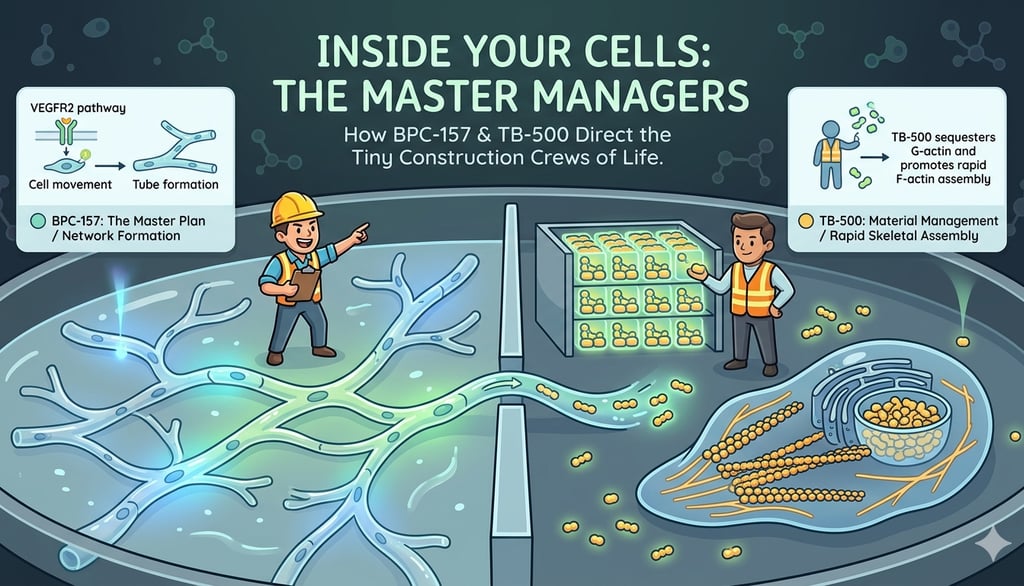
BPC-157 acts as the ultimate site foreman. In a Petri dish, if you have a group of endothelial cells (the ones that line our internal pipes), they might just sit there, idle. Add a touch of BPC-157, and it is as if the foreman has shouted, "Right, lads, we’re building!" It tells the cells exactly where to connect, how to link up, and which direction to go. It clears the red tape, allowing the cells to form intricate, tube-like networks with surprising speed. It doesn't just push the cells; it orchestrates the entire layout, ensuring the new infrastructure is built exactly where the "blueprint" says it needs to be.
The Warehouse Manager: TB-500 and the Scaffolding
While BPC-157 is busy drawing up plans for new pipes, the cell also needs to be able to move and change shape. This is where TB-500 comes in. To move, a cell relies on its skeleton, which is made of tiny building blocks called actin.
Think of actin like stacks of bricks. If the bricks are all loose and scattered in a pile, you can’t build a wall quickly when you need to. TB-500 acts like an ultra-efficient warehouse manager. It doesn't build the wall itself; rather, it keeps a massive, organized stash of these "bricks" (G-actin) ready to go.
Because the warehouse is so well-stocked and organised, the moment the cell gets the signal to move or change shape, it can snap those bricks into place instantly. This is why, in migration tests, cells treated with TB-500 seem to glide across the surface with such purpose. They aren't just faster; they are more structurally ready. They have the materials right where they need them.
Working in Tandem
You might ask, why do we need both? Think of a high-end construction project. You wouldn't want a foreman who is brilliant at directing traffic (BPC-157) if the warehouse is empty and there are no bricks to lay. Conversely, having a warehouse full of materials (TB-500) is useless if nobody is on site to tell the workers where to put the walls.
In the lab, these two provide a fascinating study in coordination. BPC-157 provides the strategic oversight and the signal to expand, while TB-500 provides the physical capability and the readily available materials to make that expansion a reality. It’s a beautifully choreographed dance of microscopic engineering, turning a static, unmoving group of cells into a dynamic, shifting, and growing team. It’s not magic—it’s just highly efficient management.
Fit Over 30 +
Contact
Jake@fitover30plus.co.uk
07446899466
© 2024. All rights reserved.