MOBILITY - STRENGTH - LONGEVITY

Multi-Receptor Agonism in Metabolic Science: A Deep Dive into Retatrutide
An analytical exploration of the unimolecular triple agonist targeting GLP-1, GIP, and Glucagon receptors. We review emerging data on its synergistic effects on metabolic rate, thermogenesis, and lipid mobilization within advanced metabolic research frameworks.
Jake James Hartley
4/23/20263 min read
The Triple-G Triple-Threat: Meet Retatrutide
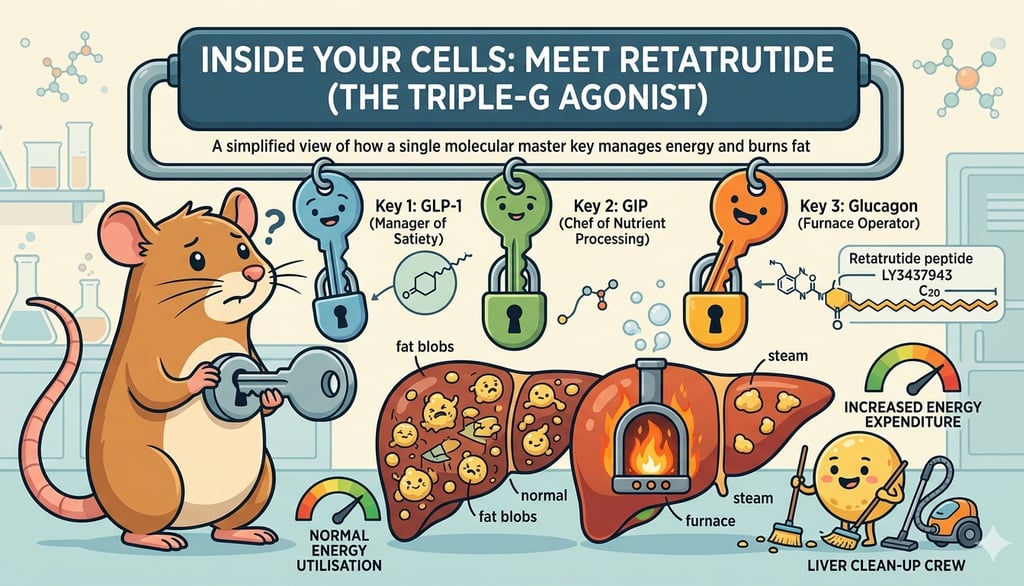
If you’ve ever tried to open three separate padlocks with a single key, you’ll know it’s usually impossible. In the body, our receptors are a bit like those padlocks—picky, stubborn, and only accepting their own specific key.
But then there’s Retatrutide (or LY3437943, if we’re being formal). Scientists have engineered this molecule to be the ultimate master key. It’s a "Triple-G" agonist, which is just a fancy way of saying it hits three different metabolic switches all at once. In the world of research, this is the equivalent of finding a cheat code for metabolism.
The "Master Key" Engineering
So, how do you make a single chain of amino acids (the building blocks of proteins) fit into three different locks?
Think of it like modifying a key. Retatrutide started as a version of the GIP hormone, but the scientists didn't stop there. They went in and meticulously tweaked the amino acid sequence. It’s like taking a standard door key and filing down the edges, adding a bit of extra metal here, and smoothing it out there, until it can slip into the GLP-1, GIP, and Glucagon locks seamlessly.
They also added a "C20 fatty acid chain"—think of this like a tether or an anchor. This keeps the key in the lock for much longer, so it doesn't just pop out before it’s done its job. It’s highly clever, precise molecular engineering.
The Triple-G Trio: What’s Actually Happening?
When these three locks are triggered, you get a beautiful, coordinated metabolic symphony. In our rodent test subjects, it looks a little something like this:
GLP-1 (The "Stop Eating" Signal): This acts like the manager of the canteen, telling the body, "Right, we’re full, put the cutlery down." It’s great at curbing appetite.
GIP (The Nutrient Processor): If GLP-1 is the manager, GIP is the chef. It makes sure that when food does come in, it’s processed efficiently and doesn’t just sit around causing chaos in the bloodstream.
Glucagon (The Metabolic Furnace): This is the star of the show. While the other two manage the intake, Glucagon turns up the heat. It tells the body to stop hoarding energy and start burning it.
Cleaning Out the Liver: The Fat Incinerator
In lab studies, the most exciting bit is what happens to the liver. Our furry little research friends often show signs of "fatty liver," where the liver acts like a cluttered warehouse, hoarding fat it doesn't need.
Retatrutide kicks the doors open. By activating that Glucagon "furnace," it triggers something called beta-oxidation. In plain English? It forces the liver to take all those stubborn fat stores and melt them down for fuel. It’s like taking a hoarded attic and clearing it out in one afternoon.
Because the rodents are essentially burning more energy than they’re taking in—and doing it more efficiently—their metabolism hits a higher gear. They aren't just sitting there; they are actively incinerating fat stores.
Why It’s a Big Deal
Retatrutide is proof that biology doesn't always have to be a one-track game. Instead of trying to fix one problem at a time, we’re learning that if you pull the right three levers at the right time, you can fundamentally change how an organism handles energy.
It’s a bit like giving a car a better engine, a better driver, and better fuel all at once. It’s not just a small tweak; it’s a total overhaul of the metabolic system. For researchers, it’s a fascinating look at what happens when you stop managing the symptoms and start managing the entire machine. It’s clever, it’s efficient, and frankly, it’s the kind of high-level tinkering that makes metabolic science so brilliant.
Fit Over 30 +
Contact
Jake@fitover30plus.co.uk
07446899466
© 2024. All rights reserved.