MOBILITY - STRENGTH - LONGEVITY

Synergistic Signaling in the GH Axis: GHRH Analogs and Ghrelin Mimetics
Documenting the complementary pathways of pulsatile GH release through the synchronization of GHRH and ghrelin receptor agonists. This entry reviews the stability of the CJC-1295 (without DAC) and Ipamorelin blend in endocrine feedback loop research.
Jake James Hartley
4/23/20263 min read
The Dynamic Duo: How CJC-1295 and Ipamorelin Keep the Cellular Beat
In the complex world of biological research, getting a cell to do exactly what you want is rarely about just hitting a "go" button. If you flood a system with constant, uninterrupted signals, the body gets confused, shuts down the response, and effectively ignores the message.
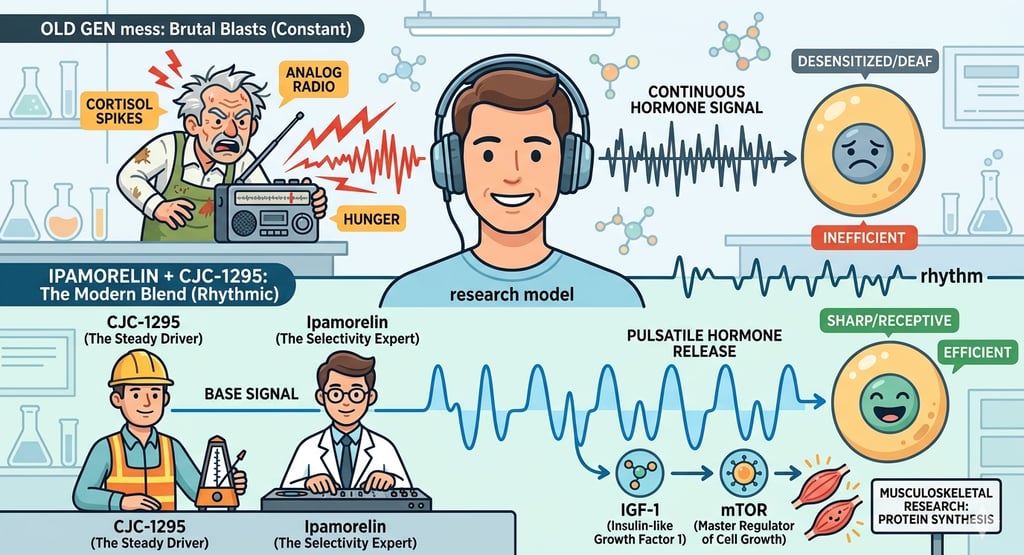
To get the best results, you need a rhythm. You need a pulse. This is why researchers are so fascinated by the "dynamic duo" of CJC-1295 and Ipamorelin. When used in tandem, they don't just blast a signal at the body; they orchestrate a natural, rhythmic release of Growth Hormone (GH). It’s not just a loud noise; it’s a perfectly timed drumbeat.
The Driver and the Selectivity Expert
To understand why this pair works, we have to look at what they actually do. Think of your pituitary gland—the master control centre for your hormones—as a highly temperamental orchestra.
CJC-1295 (The Driver): This is a GHRH (Growth Hormone Releasing Hormone) analogue. It acts like a signal booster. Its job is to tell the pituitary gland, "Right, get ready to produce some hormone." It’s designed to be long-lasting, providing a steady baseline of instruction.
Ipamorelin (The Selectivity Expert): This is where it gets interesting. Ipamorelin is a GHRP (Growth Hormone Releasing Peptide). In the bad old days, early GHRPs were like a messy apprentice. They’d get the job done, but they’d also kick the door down, cause a spike in cortisol (the stress hormone), and make you ravenously hungry by messing with ghrelin receptors. Ipamorelin is the refined, modern version. It is highly selective, meaning it triggers exactly the signal we want without the messy side effects. No cortisol spikes, no hunger pangs—just pure, targeted communication.
The Pulsatile Nature of Growth Hormone
This is the "aha!" moment for many researchers. The body doesn't want a flat, constant hum of growth hormone. It wants spikes. It wants pulses. By combining CJC-1295’s steady baseline signal with Ipamorelin’s precise trigger, this blend mimics the body’s natural, healthy rhythm of hormone release.
When you get these pulses, it’s much more effective than a constant stream. It prevents the system from "desensitising." If you keep the volume dial at 11, the cells eventually go deaf. By letting the volume dip back down between pulses, the cells stay sharp, receptive, and ready to respond when the next signal arrives.
Building Blocks: Impact on Protein Synthesis
So, what does all this pulsing actually achieve in musculoskeletal research? It’s all about the "building blocks."
When these pulses hit the target tissues, they trigger a cascade of events that significantly ramp up protein synthesis. Researchers look at specific markers—like IGF-1 (Insulin-like Growth Factor 1) and mTOR (a master regulator of cell growth).
When you have these perfectly timed hormonal pulses, the body essentially enters a "construction phase." It signals the muscle cells to start stringing amino acids together to build more proteins. It’s like a construction site supervisor suddenly finding that the supplies are plentiful and the workforce is motivated. You see an increase in the turnover of structural tissues, not because of random noise, but because of a clear, rhythmic instruction to build, repair, and maintain.
The Verdict?
CJC-1295 and Ipamorelin have become a staple in modern research because they respect the body's natural preferences. They don't try to force a biological outcome with brute, messy force. Instead, they work with the grain of the body’s own signalling system. By providing a steady guide and a selective, rhythmic pulse, this combination turns the volume up exactly where it needs to be, without the chaotic side effects of earlier research molecules. For anyone studying how to manage protein synthesis and structural integrity, it’s a masterclass in biological rhythm.
Fit Over 30 +
Contact
Jake@fitover30plus.co.uk
07446899466
© 2024. All rights reserved.